AGOD - Australian Gallery of Dreamings & EBEScontemporary have a responsibiliy to enable our indigenous artists = globally : AGOD seeks to help them eductate the world's soul & mind. SEASONS is the key to ongoing harmony (living within our means / ecosystem / climate:-
There's an unexpectedly amusing passage in the great German philosopher Immanuel Kant'sCritique of Judgment. Kant is deliberating upon lofty issues like how and why we consider something beautiful. In the course of his complicated philosophical manoeuvrings he pauses to mention, by way of example, the pleasing designs to be found in nature. And then, in a twist, he muses briefly on how the eye and mind delight in the incredible shapes and forms of ... wallpaper. Yes, wallpaper.
Kant likes wallpaper, and thinks the rest of us like it too, because the shapes to be found on a well-designed piece "mean nothing on their own, they represent nothing … and are free beauties". That's to say, we delight in the beautiful forms and shapes of wallpaper precisely because we don't relate them to anything else. The very fact that the mind doesn't really know what to do with the shapes or how to categorise them means that we can appreciate them on their own terms.
The pleasure of looking
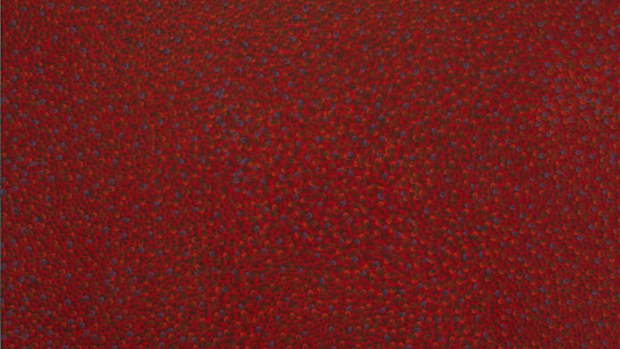
This anecdote about Kantian aesthetics has importance for art history but also for something more specific. Aboriginal Australians have for thousands of years been making art that would surely have been pleasing to the eye of Kant. This is not to make the potentially insulting claim that Aboriginal art is like wallpaper, though, in a sense that is exactly what I am saying. A person can appreciate works of Aboriginal art for the same reason that Kant appreciated wallpaper – delight at the more or less abstract play of shapes and line and colour. Personally, I have never seen wallpaper as fundamentally pleasing to look at as, say,Bush Hen Dreaming – Bush Leaves(2003) by Abie Loy Kemarre, a work that presents the viewer with a wonderful display of forms undulating across the canvas in a myriad of tiny strokes of paint.
A detail from Abie Loy Kemarre's Bush Hen Dreaming - Bush Leaves. Spike Mafford
There is beauty here in exactly the way that Kant meant the word, a beauty that comes from the pleasure of looking at designs that "mean nothing on their own". The fact that they hover just beyond the cusp of recognition results in what Kant called the "play of the imagination". The longer you stare atBush Hen Dreaming – Bush Leaves, the more this joyful cognitive-perceptual play emerges as daubs of darker colour seem to shift from the foreground to the background of the painting.
Aboriginals first painted this way on their bodies or on pieces of bark and by making designs in the sand. More recently, they've been transferring those patterns and designs onto canvases in a nod to the international art market. The works are sought after because they are beautiful in the way that Abstract Expressionist works are beautiful: the play of light and colour and shape and form delights us visually. We could easily conclude from this that Aboriginal Australians "discovered" abstract art long before any European or American artist ever hit upon the idea.
The problem is that Aboriginal Australians do not, as a rule, look at their own art in this way. Aboriginal artists aren't working with anything like a Kantian conception of a free play of the faculties and they have, in most cases, no interest in the idea of abstraction as that idea emerged in 20th century art. Indeed, many if not most Aboriginal artists are bemused by the idea of "keeping" works of art at all, since their practice is to wash off the body paint or muss up the designs in the sand after the ceremony is over. Art, for the Aboriginal artist, is less about having and keeping, and more about using and doing. The idea of putting the work on canvas only came about recently as a way for Aboriginal communities to make some extra money.
Abie Loy Kemarre was certainly not thinking about Kandinsky when she madeBush Hen Dreaming – Bush Leaves. The work, for all its abstract beauty, is a map of sorts around Kemarre's ancestral homeland. It also tracks the movements of the bush hen in its search for bush tomatoes, a quest that is mythologised in the ritual tales that Aboriginals call "The Dreaming", the central narratives that frame Aboriginal life. In short, there is quite a lot going on in the painting that is lost on a non-Aboriginal viewer. Does this matter? Can we like her painting simply for the ways it pleases the eye? Are we required to understand the painting in the way that Abie Loy Kemarre does?
Bush Hen Dreamingwas recently in a small show at the Metropolitan Museum of Art in New York City. The curator of the show, Maia Nuku, chose to exhibit the works not on the first floor, in the Arts of Africa, Oceania, and the Americas department, but on the second floor, in a "quiet area" of the Modern and Contemporary Galleries. She felt thatBush Hen Dreamingmakes more sense, to us, as a work of contemporary abstraction than as something belonging among the cultural artefacts on the first floor.
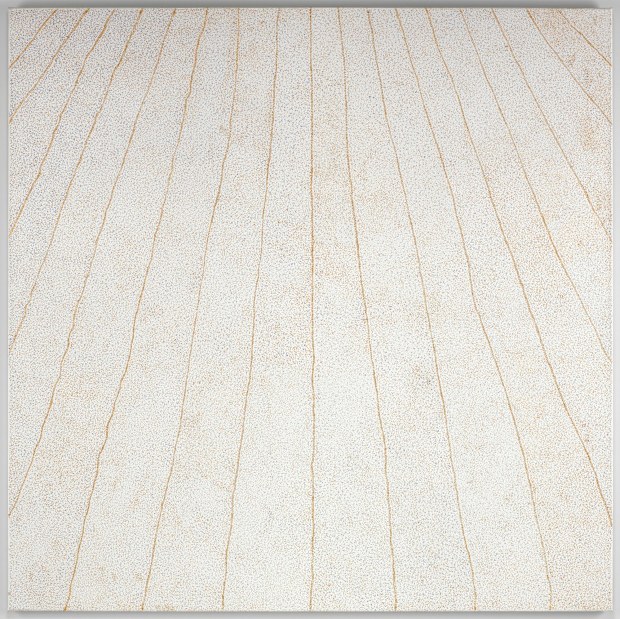
Nuku's reasoning behind her decision makes perfect sense. Just look atMountain Devil Lizard Dreaming – Sand-Hill Country (after Hailstorm)by Kathleen Petyarre. The painting is large and made with gold and blue dots of acrylic paint on a white canvas. The overall composition is minimalistic. The painting evokes a sense of slow and deliberate time, of something unfolding in an act of meditation or deep reflection.
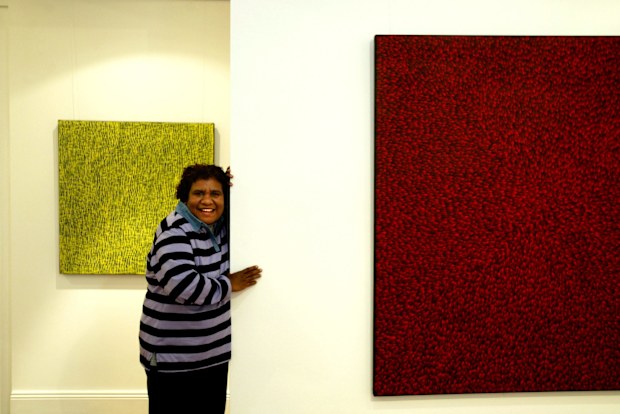
Artist Abie Loy Kemarre in 2004. Steven Siewert
I could easily be describing a painting by Agnes Martin. But that's the point, I'm not. I'm describing a painting that Petyarre came to by way of her own culture, her own practices which have nothing to do with Jackson Pollock or Martin. And yet, the paintings inOn Country: Australian Aboriginal Art from the Kaplan-Levi Giftdo seem to be in direct dialogue with all the works of abstraction that can be found elsewhere in the Met.
In an interesting discussion published on the Metropolitan Museum's website, Nuku tries valiantly to square the circle between the Aboriginal way of making art and how a (non-Aboriginal) viewer might understand them:
"Well, it's tricky! These paintings are really accessible on one level because of their formal qualities, and people talk a lot about abstraction, expressionism, the gestural quality of the work, and obviously these interpretations do allow for one vein of understanding the work.
"There are different ambitions embedded within the art I look after from Oceania. On one level the art is about what things look like, but with Indigenous art we want to help people also understand the agency of these things. What is it that the art is doing? What kinds of effects do the works generate? They're optically fertile and dynamic, so I think people are drawn to them. But then I think we have to help the visitor a bit further into a fuller understanding of the artwork itself."
In trying to understand better how to look at Australian Aboriginal art, I spent a few days in Seattle with Robert Kaplan. Kaplan and his wife Margaret Levi donated the paintings to the Met that were in the Nuku exhibition. As Bob and I looked at dozens of Aboriginal paintings hanging on the walls of their loft in central Seattle one thing became clear: It is visually stunning.
But along with the pure visual joy came a sense of sadness. The thought kept returning to my mind that Bob and I were not participating in these works of art in the way that an Aboriginal artist would participate in them. The stories of The Dreaming don't have any personal resonance for me, or for Bob, even though we are interested and intrigued by them. I should say that Bob knows a great deal about Aboriginal creation stories, and about the specific history of the paintings he's acquired. But there is a difference between knowing and "knowing". He has great sympathy for the lives and stories of Aboriginal Australians, but he likes the paintings because he likes the way they look. In the end, contrary to what Nuku proposes, there is no easy way to get from a pure aesthetic appreciation to any real understanding of what the paintings mean in their traditional context. Being told that a painting of lines and dots is actually a map of sacred sites and a set of secret codes for rituals in which you will never participate is, for me, background information and nothing more.
To be fair, Nuku is well aware of this too. That's why she begins the quote above with the phrase, "Well, it's tricky!" It is tricky. Possibly worse than tricky. It may in fact be the case that looking at Aboriginal art is an act of gazing across a cultural-civilisational divide that simply cannot be bridged.
This evokes the thought that modernity involves, in some sense, a loss, a loss of a way of being in the world. This loss cannot be reversed. Once you are in the modern world, there is no going back. A modern person can travel to the Australian outback and be told that various sites are sacred and that the sacredness comes from centuries, even millennia, of living on that land. But can a modern person experience that sense of the sacred? Not just to hear about it, but actually to experience it?
The curator of a small show of Aboriginal art at the Metropolitan Museum of Art, New York, chose to exhibit the works not on the first floor, in the Arts of Africa, Oceania, and the Americas department, but on the second floor, in a "quiet area" of the Modern and Contemporary Galleries.
Many would argue that modernity is more gain than loss, so dwelling on the loss is counterproductive. Perhaps this is true. But to compare pre-modern life (in whatever variant) with modern life along the lines of technology and convenience is already to have stacked the deck. The effect of looking at Aboriginal art is to get a glimpse, if only a glimpse, of the fact that we have also genuinely lost something by becoming modern.
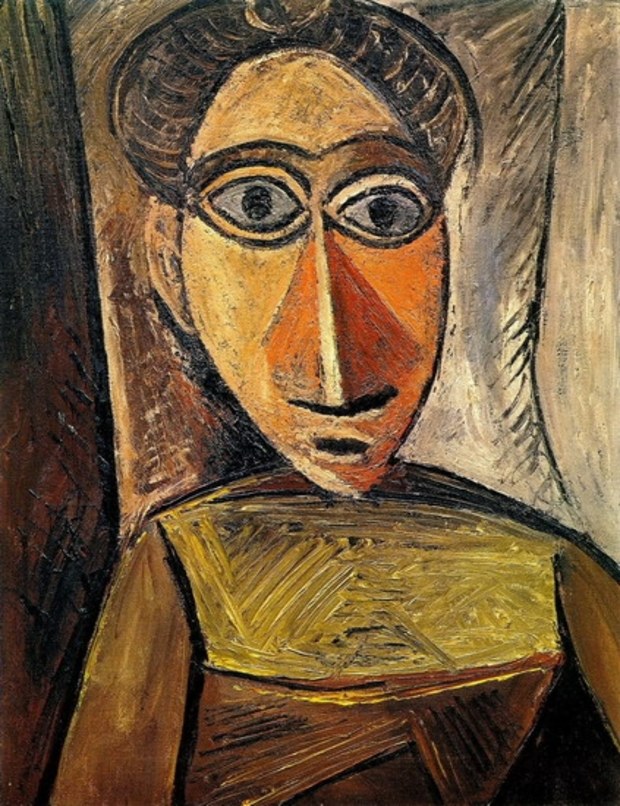
This sense of longing for a form of life that is distinctly un-modern brings us to a second route (the first being formal, purely visual appreciation) by which the overlap between Western abstract art and Aboriginal abstract art can be explored. Contemporary critics, curators, and theorists talk a lot about the formal properties of art, about brushstrokes and mark-making and so on. Modernist artists, though, were deeply interested in spiritual yearnings and constantly reflected on the theme of Modernity and loss. Take a look at the written musings of Malevich, Kandinsky, or Mondrian (just to name a few) if you do not believe me. These and many other artists of early abstraction were overwhelmingly occupied with "embarrassing" issues like spirit, God, the soul, the beyond. Many, if not most, of the "heroes" of modernism in art, from Picasso to Barnett Newman to Joseph Beuys, were shamelessly at war with modernity, to greater and lesser degrees. Here, for instance, is Picasso thinking about the importance of what he called "Negro" art.
Painting isn't an aesthetic operation; it's a form of magic designed to be a mediator between this strange, hostile world and us, a way of seizing the power by giving form to our terrors as well as our desires.
Now, if you ask your everyday person on the streets of Los Angeles or Chicago or London or Berlin for their definition of art, "magic" will probably not figure in the answer. This goes doubly for any contemporary critic or curator. But the idea that a work of art is not inert, not there to be liked or disliked or observed, but to be used in a way that can only be described as "magical" -this is an entirely disconcerting and, for most of us, counter-intuitive way to approach art. For most people who look at art, I would think, it's an affront against our sense of our own modern-ness. Nevertheless, the fact remains - a great many of the artists who are celebrated in the galleries and museums of modern art were utterly discontented with the boundaries of "the modern", of which they are often considered the exemplars.
Is the frenzy of picture taking around famous works of art, in this case the Mona Lisa, an attempt to capture the "magic" of those works? Shutterstock.com
Perhaps many museum goers sense this. Is the frenzy of picture taking around famous works of art an attempt to capture the "magic" of those works? A similar mix of desire and distress arises in the work of senior Aboriginal artist George Tjungurrayi. His meticulous linear patterning, such asUntitled(2007), creates reverberating visual rhythms that shift with subtle colour variations and which mimic the "feel" of a spear travelling through the air.
Exultation
A potentially exciting, though also deeply unsettling thought begins to emerge as one reflects upon Australian Aboriginal art and its relationship to Western abstraction. We have framed the question as "How can we relate to Aboriginal art?" Perhaps the question really should be "How can we relate to any art?" Because in many ways, the abstract expressionists were trying to make art that functions more like the art of Tjungurrayi and not the other way around. Newman, for instance, was famous for saying and writing things like, "We have lost contact with man's natural desire for the exalted, for a concern with our relation to absolute emotions." Whatever Newman meant, exactly, by "absolute emotions" he nevertheless tapped into something we can all more or less understand, if not fully define. That lost sense of exaltation seems to be precisely the sort of thing expressed by the art of Abie Loy Kemarre and plenty of other Aboriginal artists.
What is interesting is that those of us who are not Aboriginal Australians still seem to receive something meaningful in our confrontation with the paintings of Aboriginal artists, something close to Newman's lost exaltation. This comes first from the undeniably stunning visual presence of so many of these works. Christopher Hodges, an artist and art dealer in Sydney who has done much to promote Aboriginal art over the past few decades, described to me his first experience seeing a painting by then unknown but now celebrated artist Emily Kngwarreye. Hodges said he just knew he was standing in front of a great painting, by a great artist.
But what do we make of this greatness? Kngwarreye (1910-1996) only started painting when she was close to 80. She did not go to art school. Her only connection to visual culture was to the ancient traditions of Aboriginal art. But according to Hodges, she immediately began playing with those traditions on her canvases, innovating new styles with just as much boldness as a Kandinsky or Picasso. At the same time, her work never lost its sense of connection to the particularities of her land and her stories. The balance between particularity and universality somehow carries through to the rest of us. Hodges often downplays the background stories of the Aboriginal art he sells precisely to highlight the fact that the work is valid on its own terms, great simply by virtue of what the eye is confronted with on the canvas. But he is also the first to acknowledge that the works are the carriers of an embedded depth of meaning that transcends their purely formal qualities. The paintings wouldn't be so visually stunning if this greater meaning were not present.
Kngwarreye was a woman of few words. Like so many other artists, she preferred making art to talking about it. When Hodges asked her about the meaning in her paintings, she simply patted one of the canvases gently and said, "You know".
One of the last paintings Kngwarreye painted just before she died in 1996 would be hard to identify as an Aboriginal work at first glance. It looks, actually, a lot like a Lee Krasner. It's a canvas covered in red and orange and brown and a pink that has settled somewhere in the middle. But then you notice a few of those characteristic dots. Maybe the dots are the tracks of the bush hen or the devil lizard, the marks made by the haunches of a woman squatting in the desert sand, the precise location of a waterhole in the desert landscape. No matter. Kngwarreye knew the importance of those dots across her abstract landscape.
Do we, somehow, know too?
The Easel
Here, for instance, is Picasso thinking about the importance of what he called "Negro" art. Female Bust 1907. Wikiart
Morgan Meis is a US writer, a past winner of the Whiting Award and regular contributor toThe Easelwhichpublishes a weekly selection of international writing on art, includingthe fuller, original version of this essay.
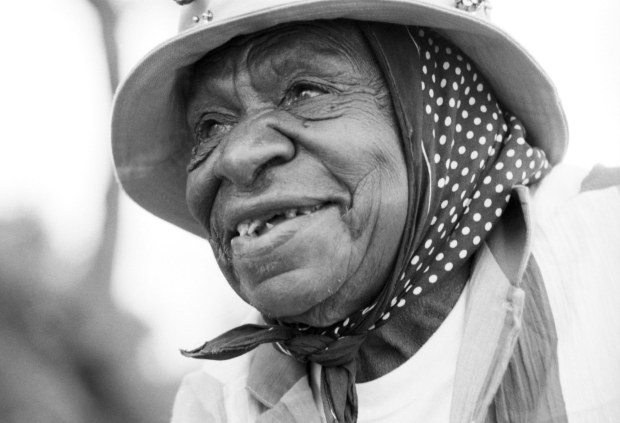
Emily Kame Kngwarreye, pictured in 1992, only started painting when she was close to 80. Rick Stevens
PLEASE note that the vast majority of this art was purchased directly from the artists decades ago. The vast majority of the artists have since deceased and this art has never left the collection. So you can be guaranteed of the quality : all come with the standard legal certificale / title. Prices are low for the fact that we own all and we sell from our home / premises. SO = you will not pay the normal 20% buyers premium from an auction house nor the 50% art gallery commission. AND we will cover all costs of delivery (and all come framed : any questions? God Bless - indigenous art is SPECIAL & this collection - Biggest and Best in the world = we think. We also conclude The Emily Wall is the most important Australian painting = agreed?
2026年8月9日
This website uses cookies This site uses cookies to help make it more useful to you. Please contact us to find out more about our Cookie Policy.