PLEASE note that the vast majority of this art was purchased directly from the artists decades ago. The vast majority of the artists have since deceased and this art has never left the collection. So you can be guaranteed of the quality : all come with the standard legal certificale / title. Prices are low for the fact that we own all and we sell from our home / premises. SO = you will not pay the normal 20% buyers premium from an auction house nor the 50% art gallery commission. AND we will cover all costs of delivery (and all come framed : any questions? God Bless - indigenous art is SPECIAL & this collection - Biggest and Best in the world = we think. We also conclude The Emily Wall is the most important Australian painting = agreed?
MORE =
https://www.ngv.vic.gov.au
https://designstore.artgallery.wa.gov.au
https://artsdaustralie.com/en/artists/yalti-napangati
Biography
Yalti Napangati was born in 1970 into the artistic community of Papunya. She lives mostly in Kiwirrkura and belongs to the Pintupi group, who were driven from their ancestral lands during colonisation. The Pintupi were grouped together in the settlement centres of the central desert, which is why they lived for a long time in the Papunya region, where contemporary Aboriginal painting was born in the 1970s. The artist borrows this iconographic vocabulary from the ritual floor paintings that she and other initiates created to commemorate the passage of her Ancestors to this sacred site and to celebrate Mother Earth. Like most painters in the Western Desert, Yalti Napangati uses dot painting. These works testify to the attachment of Aboriginal painters to their land, referring to a sacred site created in the Dreamtime by ancestral women who roamed the desert. At each of their stops, they established various rituals that the Aborigines have continued to celebrate ever since.The site in question is located in the south-west of the community of Kiwwikura (Western Australia). This is where, during the Dreamtime, a group of women stopped along the way to camp and pick edible berries known as kampurarrpa or desert grapes from the Solanum centrale, a small shrub. These berries can be eaten directly from the shrub, but are sometimes ground into a paste and cooked in charcoal to form a kind of stew. The women would then have continued their journey eastwards via the nearby site of Wirrulnga, before heading north-east to Wilkinkarra (Lake Makkay).
Following the tradition of desert painting, Yalti Napangati gives the appearance of a satellite vision of her territory, offering a highly abstract cartography combining different levels of reading. The different motifs represent the geographical features of the landscape, as well as the fruit-laden bushes and bush fodder that the women would have collected on their travels. The 'U' shapes symbolise the ancestors, accompanied by their coolamons (oval shapes) and digging sticks (vertical bars). The coolamon is a container used for many purposes: harvesting seeds and berries in the desert or carrying water. Generally speaking, they were therefore linked to traditionally feminine activities, such as looking after children and finding means of subsistence. and harvesting roots. The dotted lines that link them together symbolise the path taken, while the serpentine lines represent the tracks left by the snake as seen from the sky. The artist refers to the iconographic vocabulary of the ritual floor paintings that she and other initiates created to commemorate the passage of her ancestors to this sacred site and to celebrate Mother Earth.
Yukultji and Yalti with their family, 2019
Ben Mcnamara
National Photographic Portrait Prize 2020 Finalist
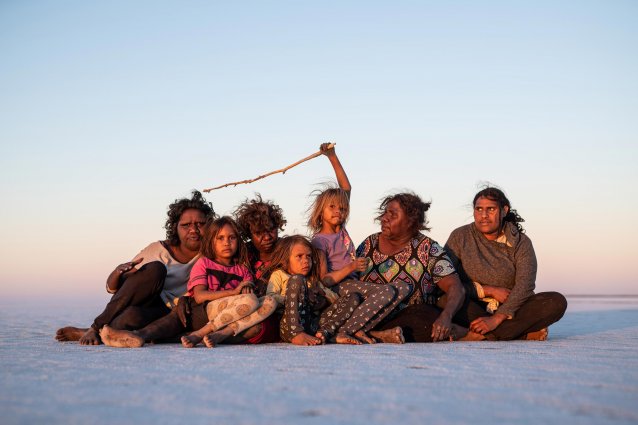
Yukultji and Yalti are members of a group referred to as ‘the Pintupi Nine’, believed to be the last Indigenous Australians to come into contact with the ‘outside’ world following European settlement. The group was still pursuing a traditional hunter-gatherer lifestyle, consistent with that lived by their ancestors for tens of thousands of years, when they came to media attention in October 1984. This photograph was taken in Pintupi country on Lake Mackay, a salt lake 100 kilometres long in the middle of the desert on the Western Australia-Northern Territory border.
https://en.wikipedia.org/wiki/Yalti_Napangati
Yalti Napangati (born c. 1970) is an Australian Pintupi artist. She is a painter of the Western Desert style of art, and paints with the Papunya Tula artist cooperative.[4] She is one of the Pintupi Nine, the last group of Aboriginal Australians living a traditional way of life in Australia. Her ex-husband, Warlimpirrnga, is also a well-known artist and member of the Pintupi Nine.[5][6]
Life
Yalti was born in the Great Sandy Desert, sometime around 1970. She and her family, the Pintupi Nine, lived as nomads in the desert, travelling along the western side of Lake Mackay.[5] Most other Pintupi families had moved into settlements during the 1950s, but Yalti's father kept the family away from these. Her parents were Lanti (or "Joshua") and Nanu.[4] She has an older brother, Tamayinya, and a younger sister, Yukultji. She married Warlimpirrnga sometime during the early 1980s, possibly when she was as young as 12.[1]
She and her family came out of the desert in 1984. She now lives at Kiwirrkurra, and has two sons and two daughters.[4]
Artistic career
Yalti finished her first paintings as part of the Papunya Tula artist cooperative in June 1996. She makes acrylic paintings of landscapes associated with Pintupi dreaming stories. Her paintings are of important places in her country, around Marruwa, Laurryi, Wirrulnga and Patjarr.[4]
References
- Toohey, Paul (4 May 2004). "The Last Nomads" (PDF). The Bulletin. Nine Entertainment Co. pp. 28–35. Archived from the original (PDF) on 4 March 2016. Retrieved 11 February 2016.
- For example, see: "The Last Nomads". Aboriginal Art Store. Archived from the original on 6 July 2011. Retrieved 27 July 2012.
- Her name is sometimes spelled Yardi, which is closer to how it sounds. Napangati is her skin name by birth, but she is sometimes written with the skin name Napaltjarri, which her "sisters" (cousins) Topsy and Takariya belong to.[2]
- Johnson, Vivien (2008). Lives of the Papunya Tula Artists. Alice Springs: IAD Press. p. 334.
- "Yalti Napangati". Honey Ant Gallery. Retrieved 27 July 2012.
- Adlam, Nigel (3 February 2007). "Lost tribe happy in modern world". Herald Sun. Herald & Weekly Times Pty Ltd.
-
 Aug. 04, 2026
YALTI NAPANGATI, "My Country", Acrylic on belgian linen., 125cm x 210cm
Est: $3,000 - $5,000YALTI NAPANGATI "My Country" Acrylic on belgian linen. Painted in 2006. Comes with Certificate of Authenticity. Artwork is stretched and ready to hang.
Ozbid Auctions -
 Apr. 28, 2025
YALTI NAPANGATI, My Country, 2024, acrylic on canvas (ready to hang), 101.5 x 141 x 3 cm. (39.9 x 55.5 x 1.1 in.)
Est: $2,000 - $3,000YALTI NAPANGATI My Country, 2024 acrylic on canvas (ready to hang) titled dated and inscribed verso; cat no. 101-1870A, with certificate of authenticity
Lawsons -
 Feb. 15, 2026
YALTI NAPANGATI, Australia (Aboriginal) (c1970 -), Tali Country, c2006, acrylic on Belgian linen, 121 x 91 x 3 cm. (47.64 x 35.82 x 1.17 in.)
Est: $2,500 - $3,500† YALTI NAPANGATI Australia (Aboriginal), (c1970 - ) Tali Country, c2006 acrylic on Belgian linen with Certificate of Authenticity in digital format including painting in progress photos, Ngintaka Arts Cat. No. 13993/51
Lawsons -
 Feb. 23, 2025
YALTI NAPANGATI, "My Country", Acrylic on linen., 101cm x 141cm
Est: $2,000 - $3,000YALTI NAPANGATI "My Country" Acrylic on linen. Painted in 2024. Comes with Certificate of Authenticity. Artwork is stretched and ready to hang.
Ozbid Auctions -
 Oct. 27, 2024
YALTI NAPANGATI, "My Country", Acrylic on linen., 101cm x 141cm
Est: $2,000 - $3,000YALTI NAPANGATI "My Country" Acrylic on linen. Painted in 2023. Comes with Certificate of Authenticity. Artwork is stretched and ready to hang.
Ozbid Auctions -
 Jan. 02, 2025
YALTI NAPANGATI, "My Country", Acrylic on linen., 101cm x 149cm
Est: $2,000 - $3,000YALTI NAPANGATI "My Country" Acrylic on linen. Painted in 2023. Comes with Certificate of Authenticity. Artwork is stretched and ready to hang.
Ozbid Auctions -
 Aug. 25, 2025
YALTI NAPANGATI, Australia (c1970 -), Tingari, 2005, acrylic on linen (ready to hang), 153 x 122 x 3 cm. (60.2 x 48.0 x 1.1 in.)
Est: $1,000 - $2,000YALTI NAPANGATI Australia, (c1970 - ) Tingari, 2005 acrylic on linen (ready to hang) inscribed verso to stretcher YALTI NAPANGATI; cat no. YAN200502; accompanied by a certificate of authenticity and (15) progress photos
Lawsons -
 Dec. 07, 2020
Yalti Napangati b.c. 1970 My Country Around Kiwirrkura, 2003 Acrylic on Belgian linen, stretched
Est: $1,000 - $1,800YaltiNapangati b.c. 1970 My Country Around Kiwirrkura, 2003 Acrylic on Belgian linen, stretched Yalti Napangati is from the Pintupi language group. This work was painted at Kintore in 2003. Provenance: Ngintaka Aboriginal Art, Alice Springs, Corroboree Exports, South Australia, Code no. 0373 Lot comes with a photograph of the artist with this painting 178 x 92 cm
Theodore Bruce Auctioneers & Valuers -
 Nov. 26, 2024
YALTI NAPANGATI (BORN CIRCA 1970), Tingari 2005
Est: $1,000 - $1,500YALTI NAPANGATI (BORN CIRCA 1970) Tingari 2005 synthetic polymer paint on canvas inscribed verso: YALTI NAPANGATI Yanda cat no. YAN200502 122 x 152.5cm PROVENANCE Yanda Aboriginal Art, Melbourne (certificate of authenticity accompanies this lot)
Gibson's -
 Sep. 06, 2021
Takeriya Napaltjarri, Pintupi/Luritja (b.c.1960), Large Rock Hole - Wirus (West of Kiwirrkura) 2000, Acrylic on Belgian linen
Est: $700 - $1,200Takeriya Napaltjarri Pintupi/Luritja, (b.c.1960) Large Rock Hole - Wirus (West of Kiwirrkura) 2000 Acrylic on Belgian linen Inscribed with the artist's name & cat. no. Ngintaka Aboriginal Art, Alice Springs Corroboree Exports, Adelaide, Certificate of Authenticity cat. no. ct00996
Theodore Bruce Auctioneers & Valuers -
 Mar. 18, 2012
YALTI NAPANGATI WOMEN'S CEREMONY 2005 synthetic
Est: $1,200 - $2,200YALTI NAPANGATI WOMEN'S CEREMONY 2005 synthetic polymer paint on canvas 46X38CM S (small size) provenance: AGOD# 10778 documentation, Papunya Tula Artists
Aboriginal Gallery of Dreamings -
 Jun. 03, 2026
YALTI NAPANGATI, Australia (Aboriginal) (c1970 -), Tingari, acrylic on canvas (ready to hang), 100 x 40 x 3 cm. (39.36 x 15 3/4 x 1.17 in.)
Est: $800 - $1,200YALTI NAPANGATI Australia (Aboriginal), (c1970 - ) Tingari acrylic on canvas (ready to hang) signed under stretcher bar with Certificate of Authenticity
Lawsons -
 Apr. 21, 2025
YALTI NAPANGATI, "Marrapinti", Acrylic on canvas., 94cm x 90cm
Est: -YALTI NAPANGATI "Marrapinti" Acrylic on canvas. Painted in 2022. Comes with Certificate of Authenticity. Artwork is stretched and ready to hang.
Ozbid Auctions -
 Jun. 22, 2023
Yalti Napangati, c. 1969, Women's Ceremonies at the Rockhole Site of Ngaminya
Est: $100 - $200Yalti Napangati c. 1969 Women's Ceremonies at the Rockhole Site of Ngaminya acrylic on linen 1998, unstretched, Papunya Tula Artists Pty Ltd., Alice Springs, cat. no. YN961198, acquired from the above in 1997, Collection of Richard Kelton and Kerry Smallwood Kelton, Santa Monica
Abell Auction -
 Sep. 19, 2022
Yalti Napangati, Pintupi (b.c.1970), Watulka- Western Australia, Acrylic on Belgian linen
Est: $450 - $650Yalti Napangati Pintupi, (b.c.1970) Watulka- Western Australia Acrylic on Belgian linen Painted at Kiwirrkura, Western Australia.
Theodore Bruce Auctioneers & Valuers -
 Dec. 07, 2017
Yalti Napangati (c. 1970 - ) Sans titre
Est: €500 - €700Yalti Napangati (c. 1970 - ) Sans titre Acrylique sur toile - 107 x 30 cm Groupe Pintupi
Millon Riviera -
 Dec. 01, 2012
Yalti Napangati Sans titre - 1999 Acrylique sur
Est: €200 - €250Yalti Napangati Sans titre - 1999 Acrylique sur toile - 30 x 60 cm Groupe Pintupi -- Kintore / kiwirrkurra - Désert Occidental Elle s'inspire ici des cérémonies qui se déroulent...
Millon & Associes -
 Nov. 14, 2013
Yalti Napangati - Untitled, 2002 91 x 61cm
Est: $700 - $900Yalti Napangati Untitled, 2002 acrylic on linen 91 x 61cm Papunya Tula Artists no.YN0210042 on verso, with Papunya Tula certificate
Lawsons -
 Nov. 14, 2013
Yalti Napangati - Untitled, 2004 91 x 46cm
Est: $600 - $800Yalti Napangati Untitled, 2004 acrylic on linen 91 x 46cm Papunya Tula Artists no.YN0408222 on verso, with Papunya Tula certificate
Lawsons -
 Nov. 25, 2012
YALTI NAPANGATI TINGARI 2004 synthetic polymer
Est: $1,400 - $2,000YALTI NAPANGATI TINGARI 2004 synthetic polymer paint on canvas 153 X 61cm provenance: AGOD# 10891
Aboriginal Gallery of Dreamings -
 Mar. 18, 2012
YALTI NAPANGATI NGAMINYA COUNTRY 2003 synthetic
Est: $4,200 - $6,800YALTI NAPANGATI NGAMINYA COUNTRY 2003 synthetic polymer paint on canvas 122X122CM M-L provenance: AGOD# 11226 documentation, Papunya Tula Artists
Aboriginal Gallery of Dreamings -
 Mar. 18, 2012
YALTI NAPANGATI KAMPURARRPA (DESERT RAISIN) 2002
Est: $3,200 - $5,000YALTI NAPANGATI KAMPURARRPA (DESERT RAISIN) 2002 synthetic polymer paint on canvas 91X91CM provenance: AGOD# 11631 documentation, Papunya Tula Artists
Aboriginal Gallery of Dreamings -
 Mar. 18, 2012
YALTI NAPANGATI KAMPURARRPA (DESERT RAISIN) 2003
Est: $3,200 - $5,000YALTI NAPANGATI KAMPURARRPA (DESERT RAISIN) 2003 synthetic polymer paint on canvas 91X91CM S-M provenance: AGOD# 11630 documentation, Papunya Tula Artists
Aboriginal Gallery of Dreamings -
 Mar. 18, 2012
YALTI NAPANGATI WOMEN'S TINGARI 2003 synthetic
Est: $3,600 - $6,500YALTI NAPANGATI WOMEN'S TINGARI 2003 synthetic polymer paint on canvas 122X61CM S provenance: AGOD# 10889 documentation, Papunya Tula Artists
Aboriginal Gallery of Dreamings -
 Jun. 25, 2026
YALTI NAPANGATI, "My Country", Acrylic on belgian linen., 125cm x 210cm
Est: $3,500 - $5,500YALTI NAPANGATI "My Country" Acrylic on belgian linen. Painted in 2006. Comes with Certificate of Authenticity. Artwork is stretched and ready to hang.
Ozbid Auctions -
 May. 20, 2026
YALTI NAPANGATI, Australia (Aboriginal) (c1970 -), Tingari, acrylic on canvas (ready to hang), 100 x 40 x 3 cm. (39.36 x 15 3/4 x 1.17 in.)
Est: $800 - $1,200YALTI NAPANGATI Australia (Aboriginal), (c1970 - ) Tingari acrylic on canvas (ready to hang) signed under stretcher bar with Certificate of Authenticity
Lawsons -
 Jun. 23, 2025
YALTI NAPANGATI, Australia (c1970 -), Tingari, 2005, acrylic on linen (ready to hang), 153 x 122 x 3 cm. (60.2 x 48.0 x 1.1 in.)
Est: $1,000 - $2,000YALTI NAPANGATI Australia, (c1970 - ) Tingari, 2005 acrylic on linen (ready to hang) inscribed verso to stretcher YALTI NAPANGATI; cat no. YAN200502; accompanied by a certificate of authenticity and (15) progress photos
Lawsons -
 Jan. 02, 2025
YALTI NAPANGATI, "My Country", Acrylic on linen., 101cm x 141cm
Est: $2,000 - $3,000YALTI NAPANGATI "My Country" Acrylic on linen. Painted in 2024. Comes with Certificate of Authenticity. Artwork is stretched and ready to hang.
Ozbid Auctions -
 Sep. 22, 2024
YALTI NAPANGATI, "My Country", Acrylic on linen., 101cm x 141cm
Est: $2,000 - $3,000YALTI NAPANGATI "My Country" Acrylic on linen. Painted in 2023. Comes with Certificate of Authenticity. Artwork is stretched and ready to hang.
Ozbid Auctions -
 Jan. 28, 2024
YALTI NAPANGARDI " Womens Ceremony " Acrylic on linen. Painted in 2023.
Est: $1,200 - $2,500YALTI NAPANGARDI "Womens Ceremony " Acrylic on linen. Painted in 2023. Comes with Certificate of Authenticity. Artwork is stretched and ready to hang. 92cm x 121cm
Ozbid Auctions