
Jack Dale Mengenen
Jack Dale Mengenen (circa 1922 – 8 February 2013) was an Australian indigenous artist, painter, and folklorist. He was also a "custodian" of the traditional culture, stories, and beliefs of his Ngarinyin people, who inhabited the Wunaamin Miliwundi Ranges of the Kimberley region of Western Australia.[1] Mengenen preserved the Dreaming stories of the Ngarinyin.[1]
Mengenen is believed to have been born circa 1922 (no record was kept of the exact year) in Mount House Station, eastern Kimberley, Western Australia.[1] His father, Jack Dale, was of Scottish descent, while his mother, Moddera, was indigenous aboriginal and member of the Komaduwah clan who had traditionally lived on the land held by the Mount House Pastoral Lease.[1][2] His father was a violent man, who was known to have murdered indigenous laborers in the area.[1] He once shot Mengenen, his own son, in the leg when he tried to run away.[1] After Mengenen's father died an early, violent death, Mengenen fled into the rural Kimberley with his Ngarinyin mother, Moddera, who raised him according to indigenous traditions.[1] He avoided Australian authorities, who would have placed in government-operated schools.[1] In 1942, Mengenen survived the Japanese attack on Broome, Western Australia, narrowly avoiding strafing from a plane. His friend was killed in the raid.[1]
He worked forty-six cattle stations throughout Western Australia as a station worker and stockman.[1] He did not begin painting art until his retirement from that line of work.[1] Other notable indigenous Australian artists who began artistic careers after leaving cattle ranching included Paddy Bedford, Jack Britten, Queenie McKenzie, and Rover Thomas.[1]
In 2000, Neil McLeod, an art dealer from the Burrinja Gallery in Melbourne, persuaded Mengenen to begin creating art based on his life and his indigenous Ngarinyin culture.[1] Mengenen traveled to Melbourne to meet with McLeod in March 2000, marking the first time that he had ever left Western Australia.[2] Mengenen produced hundreds of paintings and other pieces through his collaboration with McLeod. He formed a close friendship with McLeod.[1]
Mengenen's first solo exhibition was held at the Flinders Lane Gallery in Melbourne in 2000.[2] Examples of his portfolio of work are housed in public and private collections worldwide, including the National Museum of Australia, the Art Gallery of Western Australia, and National Parliament Collection in Canberra.[1] A major exhibition of his work was held at the Yapa Gallery in Paris, France.[1]
Jack Dale Mengenen survived 2 major strokes in 2008 and was admitted to the Numbla Nunga nursing home in Derby. It was not expected that he would paint again. He managed to make a remarkable recovery and created some of his best work with fellow artist and friend Mark Norval during 2012. These paintings were exhibited at the Sydney's Kate Owen Gallery in November 2012. Jack Dale Mengenen died in Derby, Western Australia, on 8 February 2013, at the age of 92. He is buried at the Derby cemetery. He was survived by his wife, Biddy Dale, and daughter, Edna Dale, who are both artists based in Kimberley.[1]
References
- Lee, Tim (12 February 2013). "'Grand old man of the Kimberley' dies". ABC News (Australia). Retrieved 2 March 2013.
- "Jack Dale biography". University of New South Wales Indigenous Law Centre. Retrieved 2 March 2013.
MORE =
https://artmob.com.au/artist/jack-dale/
https://en.wikipedia.org/wiki/Jack_Dale_Mengenen

Jack’s full name is Jack Dale Mengenen. He was born in the bush on Mount House Station about 1923. His mother, Moddera, was an Indigenous woman traditional to the Komaduwah clan estate that falls within the Mount House Pastoral Lease. The land enclosed by Komaduwah, as with the nearby estates of Winyaduwah and Warrakali, is characterised by steeply rising ranges interspersed with small plains, fast flowing wet season rivers that slice through deep gorges and mysterious billabongs shaded by pandanus palms and paper bark trees. Through the eyes of Indigenous people, tutored in knowledge evolved over thousands of years, these estates are ruggedly beautiful places of great abundance. Paradoxically for people less well tutored and adapted, the seductive appeal of these estates can easily give way to unforgiving circumstances that have more in common with death than with sustenance and nurture.
Jack’s father, Jack Dale the frontiersman, according to oral accounts was a hard living man, concerned for little more than the moment. Reputedly he died as violently as he had lived, and his remains were placed in the hot Kimberley earth with little ceremony or sorrow. Jack was a small boy when his father died and his knowledge of him derives largely from stories told by his mother and pastoral workers in later years. There are no records of Jack’s birth. A conservative estimate of his age based on information gleaned from the headstones of several lonely graves places him at no less than 78 years. He was born at a time when it was not uncommon for the infants of traditional women fathered by white men to be killed at birth. Such deaths could occur following instructions issued by a pastoralist, his representative, or senior Indigenous men and women concerned about future threats to traditional authority and social order. Whatever the deliberations that took place in the first few days of his life, Jack Dale is uncertain as to how or why his life was spared. Following the death of his father he grew up in the bush with his mother’s father. During this time he learned a lot about traditional law, Narrungunni and became well acquainted with station beef slain with a ‘shovel-nosed spear’.
As the child of a black woman and a white man, Jack Dale lived with the constant threat of being abducted by the police and the prospect of forced removal to institutions that neither he nor his extended family could have ever conceived of. But he was kept in the bush out of view of patrols and trackers. Children of Jack’s background were often sort after by pastoralists who saw in them the potential for specialist labour believing them to be well adapted for the rigours of open range stock work.
The political ascendancy of the pastoralists at the time also gave this youthful labour some protection from the police.
The pastoral industry provided young Indigenous men with tempting incentives. In particular, many sought the prestige conferred upon people who displayed great courage and elegance in the management of spirited horses and for throwing massive wild bulls to the ground by the tail and strapping their legs together. Jack Dale is revered among old stockmen as a man who was never thrown from a horse and never beaten by a beast. Whether black or white they warmly describe him as a skilled, tough, uncompromising stockman and bushman. Retirement has always sat heavily on Jack Dale. In recent times he has sought to rediscover and revive his experiences of bush life through art. Neil McLeod from Burrinja Gallery worked with him in 2000 and Jack came to Melbourne in March of that year. It was the first time he had left Western Australia. Jack painted nearly every day he was in Melbourne, but says he does not want to come back. He does not like flying! His work represents a unique first hand pictorial account of a largely unknown and never to be repeated chapter of Australian history.
Jack Dale is Kimberley personified. His life has been filled with the unique experiences of a quick witted and honest man. His sometimes mischievous, though subtly crafted humour reflects his mastery of Ngarinyin, the language of his birth, and several other Indigenous Kimberley languages. He is as real and as fair dinkum as it gets.
KEVIN SHAW
Consulting Anthropologist
Jack passed away on February 9 2013.
Notes re the ochre colours used by Jack Dale
Yellow – Gum Bar Ru
Frilled Neck lizard fat and carpet snake.
There are certain rocks which represent the fat (kidney fat). When yellow colour is needed this rock is broken.
Red – Jimbiri or Jadal
The dark red ochre is the colour of Wadi the Nightjar bird, we call Jimbiri.
The light red is Jungun Nightjar Jadal.
White – is the droppings from the snake, eaglehawk and perentie lizard.
The aboriginal name is Unmul.
Black – No Wandjina made black, it is just burnt logs. We don’t have to go far to get it. Black represents the colour of our skin.
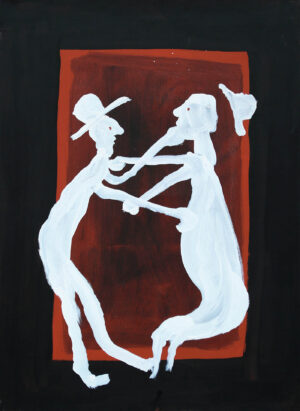
AM 14442/17
$2,500 (tax inc.)View artwork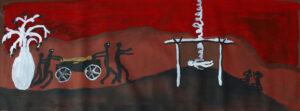
AM 14444/17
$6,500 (tax inc.)View artwork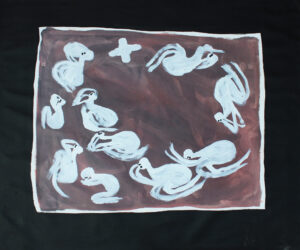
AM 14445/17
$4,500 (tax inc.)View artwork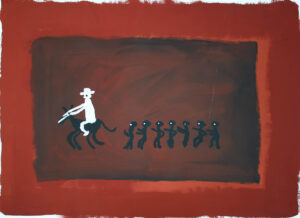
AM 14534/17
$3,000 (tax inc.)View artwork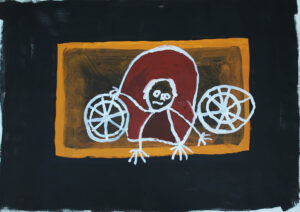
AM 14535/17
$5,000 (tax inc.)View artwork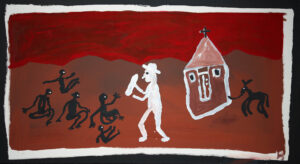
AM 14536/17
View artwork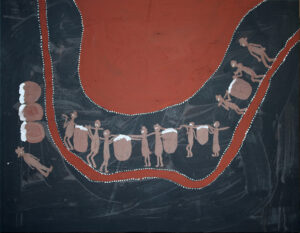
AM 15143/18
View artwork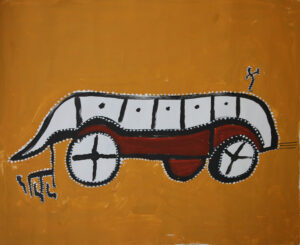
AM 15144/18
$5,500 (tax inc.)View artwork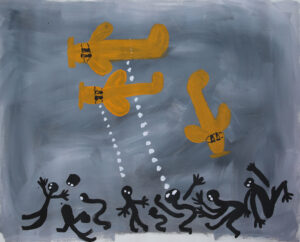
AM 15145/18
View artwork
AM 16450/19
$14,000 (tax inc.)View artwork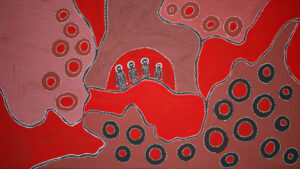
AM 16451/19
View artwork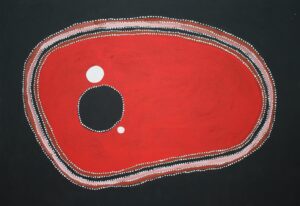
AM 16452/19
$12,000 (tax inc.)View artwork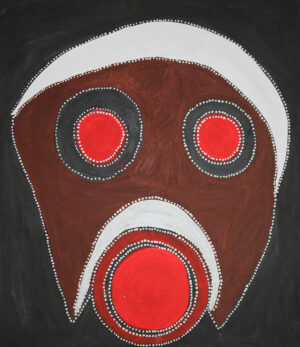
AM 16453/19
$10,000 (tax inc.)View artwork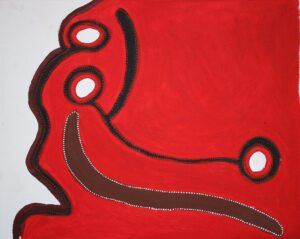
AM 16455/19
$8,000 (tax inc.)View artwork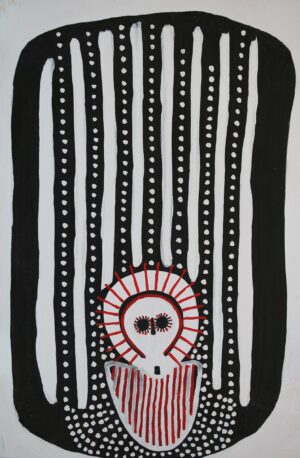
AM 16456/19
View artwork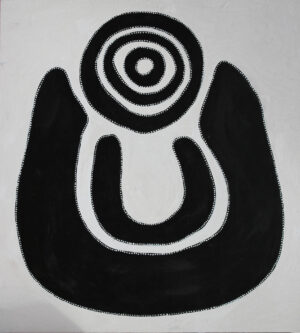
AM 16457/19
View artwork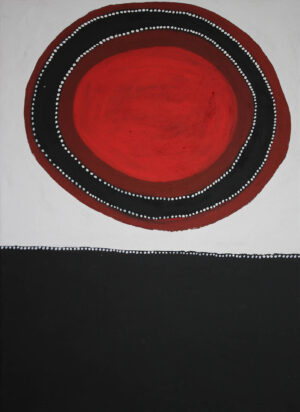
AM 16458/19
View artwork
AM 16459/19
View artwork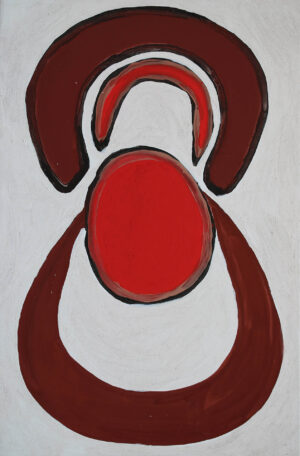
AM 16460/19
$8,000 (tax inc.)View artwork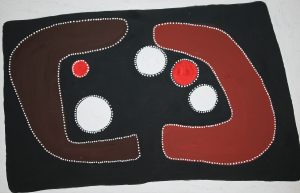
AM 16461/19
View artwork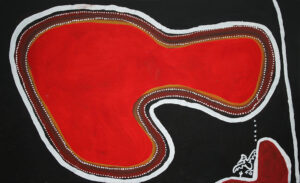
AM 16462/19
$13,500 (tax inc.)View artwork