-
-
OVERVIEW
Measuring five metres in height and fifteen metres in width, The Emily Wall is a large-scale composition that demonstrates the strength and complexity of Emily Kame Kngwarreye’s vision. Completed in 1995, the work consists of fifty-three acrylic panels on canvas, unified to create a single monumental piece. It presents the cycles of the desert with clarity and vitality, capturing the blossoms, landscapes, and rhythms of Utopia in a way that reflects both cultural knowledge and Emily’s distinctive artistic style.
At the centre is a dominant panel that grounds the composition. Hugging this central piece is a diptych, an arrangement that establishes balance and movement, drawing the viewer’s attention across the wall. Surrounding these are fifty canvases, each measuring four by three feet, filled with Emily’s recognisable blooms and layered brushwork. Together, they create a dynamic surface where forms and colours build on one another to express the spirit of Country.
The Emily Wall conveys more than visual impact; it embodies the cycles of seasonal change, the continuity of culture, and the enduring presence of the land. Having travelled to international exhibitions in Amsterdam, Japan, Denmark, and Germany, it now stands as a key work within Emily’s celebrated legacy. This major ensemble of panels represents not only her artistic achievement but also her lasting contribution to the recognition of Aboriginal art worldwide.
This masterpiece is more than a collection of panels; it is a symphony of land, life, and legacy. To stand before it is to be enveloped in a world that celebrates the depth of Emily Kame Kngwarreye’s imagination and the enduring resonance of her extraordinary connection to country.
-
BEHIND THE SCENES: The Creation of 'The Emily Wall'
-
'The CONCEPT'
written by hank ebes (2009)It was October 23, 1994 when my daughter Tara and I met up with Fred Torres and his famous mother, artist Barbara Weir, to journey to Utopia and spend the day with Emily. We had flown into the Alice from Darwin after a trip to Bathurst and Melville Islands to source artworks for our Melbourne gallery. The weather was perfect and we set off in high spirits, well prepared with two video cameras, loads of 35mm film, food and drinks to supply an army and anxious to get on the road for the four hour drive. No matter how often I rattle, shake and roll the corrugated road to Arlparra store and Irultja, I never get tired of it. The ever-changing landscape, the colours of the arid bush, the wildlife (lunch on legs for Barb who can spot a lizard at 75 paces and land it on the back seat in 5 minutes flat) and the magnificent sky, day or night, make the trip seem shorter than it is. Especially at night, without the interference of artificial light, the starry, starry night is awesome especially for a meteorite collector like me.
Fred and Barb had been supplying us with Emily's paintings for our Melbourne gallery for several years and had invited us to visit Emily's country, with the by now internationally famous artist as our guide, to get a better understanding of her vision of the land she portrayed so brilliantly and prolifically.
Family love and respect made sure that Emily was well looked after, protected and lived life to the max, painting only when she wanted to and enjoying family trips interstate when not living a traditional lifestyle at home. It was during this trip that I suggested to Emily that at her 'senior' age, to cut back on her painting time while still earning royalties from reproductions, she forcefully admonished me with the never forgotten statement: 'I don't paint, I die.'
Our day was spent driving with Emily firmly wedged on the back seat between Barb and Tara through her magnificent country, gently patting my hand as I hang on to the back of the passenger seat, with my back towards the windscreen, videotaping the ladies conversations and visiting important sites where Emily's dreamtime stories were born. Emily directed Fred to special places where Barb would tell us the story related to specific paintings, pointing out what Emily painted in so many different styles and colours: trees, grasses, flowers, hills, myth scapes and the songs that celebrated them.
It was then, after tasting a rather gritty bush honey - produced by Emily on the end of a stick from the fallen hollow tree trunk she was perched on - that I conceived the idea to commission Emily to paint one giant mural over a one year period featuring her 'whole lot, that's what I paint' philosophy and the changing seasons.
In the shade of - and underneath her favourite tree with the video camera rolling, we discussed the project and planned a strategy. Emily was happy to paint her vision over the planned 12 months and the inherently leisurely pace. First and foremost we needed permission from the traditional owners of the land, Greeny Purvis and Lyndsey Bird. After lunch, during which I thought Emily ate at least half a dozen chicken sandwiches - until l discovered she was storing them in her bra for a rainy day - we packed up and headed for Greeny's camp. A fabulous artist in his own right, this charming 'old Man' listened carefully to our proposition and gave his blessings if we would also commission a painting especially produced by both Greeny - as the 'owner' of the land - and Emily together for the internationally travelling exhibition Nangara that we were in the process of putting together, and the catalogue that was to be produced for this project. After more photographs and video of all of us we said our goodbyes to Emily and friends and headed back to the Alice.
Thanks to Fred and Barbara, the paintings for the Emily Wall started arriving in Melbourne regularly during the year in addition to other commissioned works for our gallery stock. Each new arrival for 'the Wall' seemed better than the last and all fifty of the 120 X 90 cm panels were topped by the large triptych centrepiece delivered by Fred in late 1995 completing the project. Before the publication of the Nangara catalogue (that had become a comprehensive book about the collection and was translated in five languages and eventually gone to print in December 1995) all the individual photographs of the Emily Wall panels were taken back to Emily in the bush by our friend and field officer Allan Glaetzer, to show them to Emily and get her to lay them out in the five horizontal rows pattern planned for the exhibition design.
The inaugural venue for the Nangara exhibition was in Bruges, Belgium in March 1996. This was also the first time the Emily Wall was presented. When the final panel was placed in position to complete the Wall, it brought tears to the eyes of most of us, including Barbara Weir and Fred and family, who visited us shortly after the opening. The Emily Wall remained in Europe for more than a decade and featured at the first international and highly acclaimed solo exhibition of Emily in Amsterdam in 1999. More than 100 of her works, including 12 of the famous 'Final Series', painted just weeks before her death in September 1996, surrounded the Emily Wall in the 13th century exhibition venue De Oude Kerk. After a six month exhibition in Arken, Denmark's Museum of Contemporary Art, the entire Nangara collection was shipped back to Oz and the Emily Wall now hangs in my living room where I am daily reminded not just of the genius of Emily, but of one of the most memorable and best days of my life, made possible by Fred. Thanks mate.
-
- INSTALLATION OF 'THE EMILY WALL' : NANGARA (1996)
-
EXHIBITIONS FEATURING: 'THE EMILY WALL'
-
-

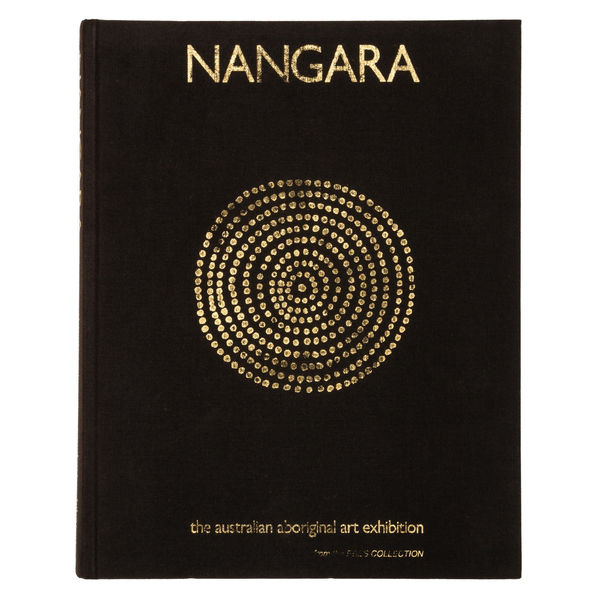
NANGARA: The Australian Aboriginal Art Exhibition
From The Ebes Collection 9 Marzo - 23 Junio 1996In 1996, within the vaulted halls of Oud Sint-Jan in Bruges, a landmark exhibition unfolded — Nangara . It brought together more than 350 works by over 108 Aboriginal artists... -
EMILY IN AMSTERDAM: Oude Kerk, Amsterdam
From the Ebes Collection 20 Mayo - 22 Agosto 1999In 1999, a landmark moment in the recognition of Aboriginal art took place inside one of Europe’s most atmospheric venues—the Oude Kerk in Amsterdam. Built in the 13th century and... -
The Lume: Connection
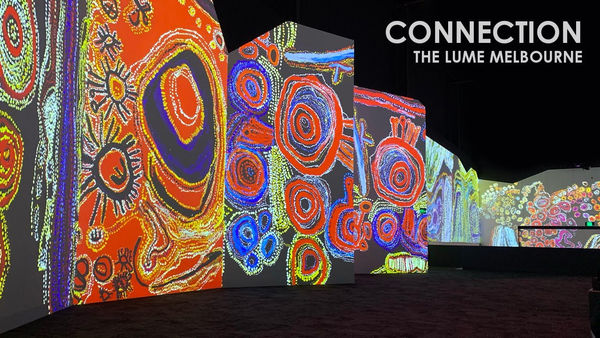
A Collaboration with Grande Experiences 23 Junio 2023 - 4 Febrero 2024Overview Connection , a truly groundbreaking immersive exhibition that brought together the work of more than 110 First Nations artist from across Australia. First launced at the National Gallery of...
-